
Geography of Japan
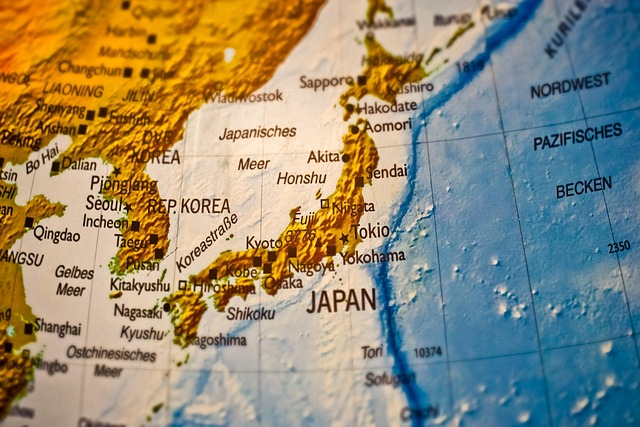
The Japanese archipelago was formed over millions of years by volcanic activity and tectonic plate movements along the Pacific "Ring of Fire," resulting in a mountainous landscape with limited arable land. Roughly 30,000 to 40,000 years ago, Paleolithic humans migrated to the islands from mainland Asia during a period when land bridges existed. As sea levels rose, Japan became an isolated archipelago, creating a unique, sheltered environment that allowed early Jōmon hunter-gatherer culture to develop distinct pottery and traditions. Around 300 B.C., agricultural advancements, specifically wet-rice cultivation, arrived from China and Korea during the Yayoi period, initiating a shift toward settled societies and hierarchical social structures. The country's mountainous geography, which covers over 75% of the land, necessitated the development of coastal, high-density residential zones and terrace farming. Throughout its history, this island geography, coupled with a maritime climate, encouraged the development of a unique culture while providing a natural defense against foreign invasion, such as the failed Mongol attempts in the 13th century. Furthermore, the archipelago's location has historically necessitated high levels of adaptation to seismic activity and natural disasters.
major cities of japan
Major cities in Japan, such as Tokyo, Osaka, and Nagoya, generally have a temperate, humid subtropical climate with four distinct seasons: hot, humid summers and mild to cool winters. Northern cities like Sapporo experience cold, snowy winters, while southern cities like Kagoshima are subtropical, experiencing warmer winters and hotter, humid summers. learn more at climate page for seasonal insight
- tokyo
- As the capital, it is the center of government, culture, and business, and the heart of the world's most populous metropolitan area.
- yokohama
- Located just south of Tokyo, it is Japan's second-largest city and a major port and industrial hub.
- Osaka
- The third-largest city, acting as the economic heart of the Kansai region and famous for its food culture.
- nagoya
- The fourth-largest city, located between Tokyo and Osaka, is a central hub for manufacturing, particularly the automotive industry